


Electric Vehicles, Smart Drives, and Simulation-Based Engineering Research: Future Directions for Sustainable Mobility
Electric Vehicles, Smart Drives, and Simulation-Based Engineering Research: Future Directions for Sustainable Mobility
The global transportation sector is undergoing one of the most significant technological transformations in modern history. Rising environmental concerns, stricter emission regulations, advancements in battery technology, and rapid digitalization are accelerating the transition from conventional vehicles to electric mobility solutions.
Electric Vehicles (EVs) have emerged as a cornerstone of sustainable transportation, while smart drive technologies and simulation-based engineering are enabling researchers and manufacturers to develop safer, more efficient, and intelligent mobility systems. These developments are not only reshaping the automotive industry but also creating new opportunities for innovation across electrical engineering, electronics, computer science, mechanical engineering, artificial intelligence, and renewable energy systems.
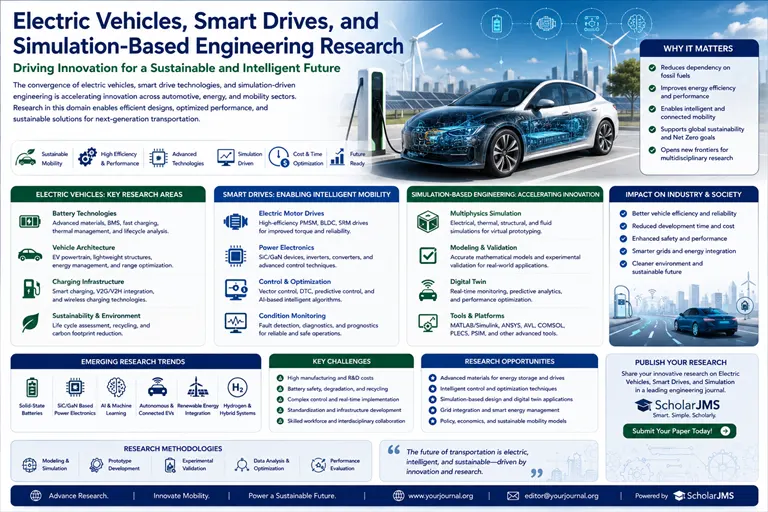
For progressive engineering journals such as the Future Edge Journal of Progressive Research (FEJPR), research in electric mobility and intelligent transportation systems represents a rapidly growing area of scientific and technological importance.
This article explores the latest trends, research opportunities, and future directions in electric vehicles, smart drives, and simulation-based engineering.
The Rise of Electric Mobility
Transportation contributes significantly to global greenhouse gas emissions. Governments worldwide are promoting electric mobility through:
- Policy incentives
- Emission regulations
- Charging infrastructure development
- Renewable energy integration
- Research and innovation funding
As a result, electric vehicle adoption is increasing across:
- Passenger vehicles
- Commercial transportation
- Public transit systems
- Industrial vehicles
- Agricultural machinery
- Two-wheelers and three-wheelers
The engineering challenges associated with EV development continue to drive substantial research activity worldwide.
Understanding Electric Vehicle Technology
An electric vehicle operates using electric motors powered by rechargeable energy storage systems rather than internal combustion engines.
Core Components of Electric Vehicles
- Battery Pack
- Electric Motor
- Power Electronics
- Motor Controller
- Battery Management System (BMS)
- Charging System
- Thermal Management System
- Regenerative Braking System
Each subsystem requires extensive engineering optimization to achieve efficiency, reliability, safety, and cost-effectiveness.
Why Electric Vehicle Research Matters
Electric vehicle research contributes to:
- Carbon emission reduction
- Energy efficiency improvement
- Reduced dependence on fossil fuels
- Sustainable urban transportation
- Smart grid integration
- Renewable energy utilization
Researchers continue to investigate methods for improving EV performance while reducing manufacturing and operational costs.
Smart Drive Technologies: Transforming Modern Mobility
Smart drives refer to intelligent motor control systems that optimize vehicle performance through advanced sensing, communication, and automation technologies.
Objectives of Smart Drive Systems
- Improve energy efficiency
- Enhance driving performance
- Increase safety
- Optimize battery usage
- Support autonomous functionality
- Enable predictive maintenance
These technologies form the foundation of future intelligent transportation systems.
Key Components of Smart Drive Systems
Advanced Electric Motor Drives
Modern EVs utilize:
- Permanent Magnet Synchronous Motors (PMSM)
- Brushless DC Motors (BLDC)
- Induction Motors
- Switched Reluctance Motors
Researchers focus on improving:
- Torque density
- Energy efficiency
- Reliability
- Thermal performance
- Cost-effectiveness
Intelligent Motor Control Algorithms
Smart control systems utilize:
- Artificial Intelligence
- Machine Learning
- Fuzzy Logic Controllers
- Adaptive Control Systems
- Predictive Control Techniques
These approaches enable dynamic optimization under varying driving conditions.
Sensor Integration
Modern electric vehicles incorporate sensors that monitor:
- Speed
- Temperature
- Battery health
- Torque
- Motor performance
- Vehicle stability
Real-time sensor data supports intelligent decision-making and operational efficiency.
Simulation-Based Engineering: A Game Changer
One of the most transformative developments in engineering research is the increasing use of simulation-based design and analysis.
Simulation enables engineers to evaluate complex systems virtually before physical implementation.
Benefits of Simulation-Based Engineering
- Reduced development costs
- Faster product development
- Improved design accuracy
- Enhanced system reliability
- Lower prototyping requirements
- Better risk assessment
Simulation technologies have become indispensable in EV research and development.
Applications of Simulation in Electric Vehicle Research
Battery System Modeling
Battery performance significantly affects EV reliability and efficiency.
Simulation tools help researchers analyze:
- Charging behavior
- Discharging characteristics
- Thermal management
- Aging mechanisms
- Safety performance
These models improve battery design and lifecycle management.
Electric Motor Simulation
Engineers use simulation platforms to study:
- Electromagnetic fields
- Motor efficiency
- Torque generation
- Thermal behavior
- Fault conditions
This reduces development time while improving performance.
Vehicle Dynamics Simulation
Researchers evaluate:
- Acceleration
- Braking performance
- Energy consumption
- Stability
- Handling characteristics
before building physical prototypes.
Power Electronics Analysis
Simulation assists in optimizing:
- Inverters
- Converters
- Control systems
- Switching strategies
- Power management architectures
for improved system efficiency.
Artificial Intelligence in EV and Smart Drive Research
Artificial Intelligence is becoming increasingly important in electric mobility systems.
AI Applications Include
- Battery health prediction
- Energy management optimization
- Driver behavior analysis
- Autonomous driving support
- Predictive maintenance
- Traffic optimization
Machine learning algorithms help improve operational efficiency while reducing maintenance costs.
Digital Twins in Electric Vehicle Development
Digital twin technology creates virtual replicas of physical systems.
Researchers use digital twins to monitor:
- Vehicle performance
- Battery health
- Motor conditions
- Thermal systems
- Charging behavior
Digital twins allow continuous optimization throughout a vehicle's lifecycle.
Renewable Energy Integration and EV Ecosystems
Electric vehicles are increasingly being integrated with renewable energy systems.
Research Areas
- Solar-powered charging stations
- Smart grid connectivity
- Vehicle-to-Grid (V2G) systems
- Vehicle-to-Home (V2H) systems
- Renewable energy storage
These technologies contribute to more sustainable energy ecosystems.
Emerging Trends in Electric Vehicle Engineering
1. Solid-State Batteries
Solid-state batteries offer:
- Higher energy density
- Improved safety
- Faster charging
- Longer lifespan
This technology is expected to significantly influence future EV designs.
2. Wireless Charging Systems
Researchers are developing:
- Static wireless charging
- Dynamic wireless charging
- Inductive charging systems
These innovations could improve user convenience and vehicle adoption rates.
3. Autonomous Electric Vehicles
Future mobility systems are expected to combine:
- Electric propulsion
- Artificial Intelligence
- Advanced sensing
- Autonomous navigation
This convergence creates significant interdisciplinary research opportunities.
4. Lightweight Materials for EVs
Researchers are exploring:
- Advanced composites
- Nanomaterials
- High-strength alloys
- Sustainable materials
to improve vehicle efficiency and range.
5. Advanced Thermal Management
Thermal management remains critical for:
- Battery safety
- Motor efficiency
- Electronics reliability
Innovative cooling technologies continue to be an active research area.
Research Challenges in Electric Mobility
Despite significant progress, several challenges remain.
Battery Limitations
Current battery technologies still face concerns related to:
- Cost
- Charging time
- Range anxiety
- Resource availability
Charging Infrastructure
Many regions require expanded charging networks to support large-scale EV adoption.
Grid Integration
The growing number of EVs creates challenges for electricity distribution systems.
Cybersecurity Risks
Connected vehicles introduce new security concerns related to data privacy and system protection.
System Complexity
Modern EVs combine multiple engineering disciplines, increasing design and management complexity.
Future Research Opportunities
Researchers can contribute to:
- Intelligent battery management systems
- AI-driven motor control
- Smart charging infrastructure
- Autonomous electric mobility
- Vehicle-to-grid technologies
- Advanced simulation methodologies
- Sustainable transportation systems
- Cybersecure mobility platforms
- Digital twin applications
- Renewable energy integration
These areas are expected to generate substantial research activity in the coming decade.
Why Simulation-Based Research Is Becoming Essential
Engineering research increasingly relies on virtual experimentation.
Simulation allows researchers to:
- Validate concepts rapidly
- Reduce development costs
- Improve design quality
- Accelerate innovation cycles
- Analyze complex interactions
For electric vehicles and smart drive technologies, simulation-based methodologies are becoming standard practice across academia and industry.
Opportunities for Academic Researchers
Electric mobility research offers opportunities for scholars in:
- Electrical Engineering
- Mechanical Engineering
- Electronics Engineering
- Computer Science
- Artificial Intelligence
- Renewable Energy Systems
- Mechatronics
- Industrial Engineering
The interdisciplinary nature of EV technologies encourages collaboration across multiple domains.
Frequently Asked Questions
Why are electric vehicles important for sustainable development?
Electric vehicles help reduce greenhouse gas emissions and improve energy efficiency while supporting renewable energy integration.
What are smart drive systems?
Smart drive systems use intelligent control technologies to optimize vehicle performance, energy efficiency, and safety.
Why is simulation important in EV engineering?
Simulation reduces development costs, improves design quality, and enables engineers to evaluate complex systems before physical implementation.
How is AI used in electric vehicle research?
AI supports battery management, predictive maintenance, autonomous driving functions, and intelligent energy optimization.
What are the major challenges facing EV adoption?
Battery costs, charging infrastructure, grid integration, cybersecurity, and resource availability remain significant challenges.
Conclusion
Electric vehicles, smart drive systems, and simulation-based engineering are transforming the future of transportation and sustainable mobility. Advances in battery technology, intelligent control systems, digital twins, artificial intelligence, and renewable energy integration are creating unprecedented opportunities for engineering innovation.
As governments, industries, and researchers work toward cleaner and more intelligent transportation systems, interdisciplinary research in electric mobility will continue to expand in importance.
The Future Edge Journal of Progressive Research (FEJPR) recognizes the growing significance of electric vehicle technologies, smart drives, and simulation-based engineering. Researchers, academicians, and industry professionals are encouraged to contribute original research, review articles, and innovative case studies that advance the future of sustainable mobility and intelligent transportation systems.
Submit Your Research to FEJPR
FEJPR welcomes high-quality submissions in:
- Electric Vehicle Engineering
- Smart Drive Technologies
- Power Electronics
- Renewable Energy Systems
- Artificial Intelligence Applications
- Intelligent Transportation Systems
- Simulation-Based Engineering
- Sustainable Mobility Research
Together, researchers can contribute to building cleaner, smarter, and more sustainable transportation solutions for future generations.