


How to Start an Online Engineering Journal in 2026: Website, ISSN, DOI, Peer Review and Indexing Checklist
How to Start an Online Engineering Journal in 2026: Website, ISSN, DOI, Peer Review and Indexing Checklist
The global engineering research ecosystem is evolving rapidly. Universities, engineering colleges, professional societies, and research institutions are increasingly launching their own scholarly journals to provide dedicated platforms for publishing innovative research in areas such as artificial intelligence, renewable energy, advanced manufacturing, electronics, civil infrastructure, sustainable engineering, and interdisciplinary technologies.
The launch of the Future Edge Journal of Progressive Research (FEJPR) reflects this growing trend toward creating credible, accessible, and technology-driven academic publishing platforms for engineering researchers.
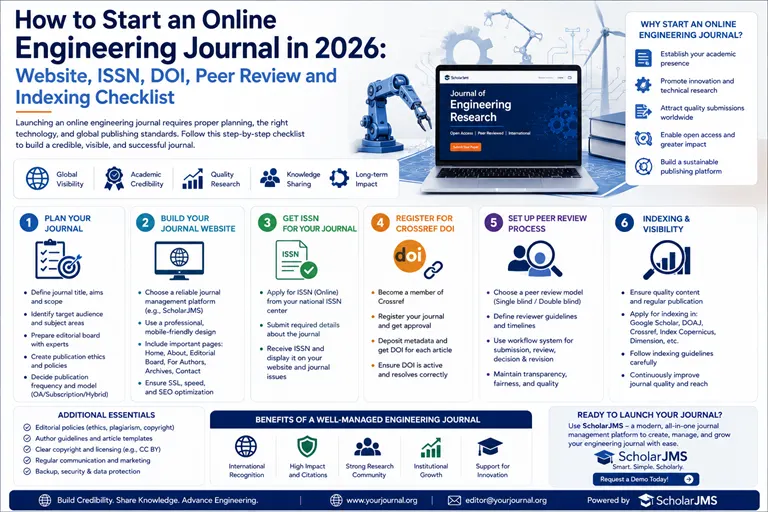
However, starting an engineering journal in 2026 involves much more than simply creating a website and inviting submissions. A successful journal requires careful planning, robust editorial workflows, international publishing standards, and a long-term indexing strategy.
This guide provides a practical roadmap for universities, editors, and journal founders who want to establish an online engineering journal that is credible, sustainable, and ready for future growth.
Why Start an Engineering Journal in 2026?
Engineering research is becoming increasingly interdisciplinary. New fields such as:
- Artificial Intelligence and Machine Learning
- Renewable Energy Systems
- Electric Vehicles
- Smart Manufacturing
- Sustainable Infrastructure
- Materials Science and Nanotechnology
- Robotics and Automation
- Industry 5.0 Technologies
are generating enormous amounts of research output.
Many institutions face challenges such as:
- Limited publication opportunities in niche engineering domains
- Long review timelines in established journals
- Lack of regional research representation
- Need for institution-owned publishing platforms
- Desire to improve research visibility and academic reputation
Launching an engineering journal can help institutions:
- Showcase institutional research excellence
- Build academic collaborations
- Increase research visibility
- Support faculty and doctoral scholars
- Create a long-term scholarly publishing ecosystem.
Step 1: Define the Journal's Scope and Vision
Before developing the journal website, clearly define:
Journal Title
Choose a unique and memorable title that reflects the journal's subject focus.
Aim and Scope
Determine:
- Core engineering disciplines
- Interdisciplinary coverage
- Target audience
- Types of articles accepted
- Publication frequency
Examples of engineering subject areas include:
- Mechanical Engineering
- Electrical Engineering
- Computer Science
- Civil Engineering
- Electronics and Communication Engineering
- Renewable Energy
- Data Science
- Industrial Engineering
- Environmental Engineering
- Materials Science
A well-defined scope improves indexing readiness and helps authors understand the journal's objectives.
Step 2: Establish the Editorial Structure
A credible editorial structure is essential.
Editorial Team Should Include
- Editor-in-Chief
- Managing Editor
- Associate Editors
- Editorial Board Members
- Technical Editors
- Reviewer Panel
When selecting editors:
- Include experts from multiple institutions.
- Maintain international representation.
- Publish complete editorial information on the website.
- Define editorial responsibilities clearly.
Strong editorial governance significantly improves journal credibility.
Step 3: Develop a Professional Journal Website
A journal website is the digital foundation of the publication.
A modern engineering journal website should include:
- Home Page
- About Journal
- Aim and Scope
- Editorial Board
- Author Guidelines
- Reviewer Guidelines
- Publication Ethics
- Current Issue
- Archive
- Submit Manuscript
- Contact Information
- Copyright Policy
- Privacy Policy
Why Journal Management Software Matters
Managing submissions manually through email becomes difficult as the journal grows.
A dedicated journal management platform can automate:
- Manuscript submissions
- Peer review workflows
- Editorial decisions
- Author communications
- Article publication
- Metadata generation
- DOI integration
Platforms such as ScholarJMS provide an integrated solution for:
- Journal website development
- Manuscript submission management
- Editorial workflow automation
- Online publishing
- DOI-ready article management
- Publication archives
Modern journal platforms significantly reduce administrative workload and improve publication efficiency.
Step 4: Obtain an ISSN for the Journal
An International Standard Serial Number (ISSN) is one of the first requirements for establishing journal credibility.
Why ISSN Is Important
ISSN helps:
- Identify the journal globally
- Improve discoverability
- Enable indexing applications
- Establish publishing legitimacy
- Support library cataloguing
Documents Commonly Required
- Journal website
- Editorial board information
- Publishing policies
- Sample issue or publishing plan
- Publisher information
Many new journals struggle because their websites are not fully prepared for ISSN evaluation.
Professional support from publishing consultants can simplify this process and improve readiness.
Need assistance with ISSN consulting and journal website preparation?
OJSCloud assists new journals with:
- Journal launch consulting
- Website readiness
- ISSN guidance
- Publishing workflows
- Technical support
WhatsApp: +91 82003 85143
Email: inquiry@ojscloud.com
Step 5: Create a Transparent Peer Review Workflow
Peer review remains the foundation of scholarly publishing.
Engineering journals typically adopt:
Single-Blind Review
Reviewers know author identities.
Double-Blind Review
Both authors and reviewers remain anonymous.
Open Peer Review
Review reports are published alongside articles.
A standard workflow usually includes:
- Manuscript submission
- Initial editorial screening
- Reviewer assignment
- Review process
- Revision stage
- Editorial decision
- Copyediting
- Publication
Modern systems help editors track every stage efficiently.
Emerging research ecosystems are also exploring transparent peer review practices through platforms such as Scholar9, which aim to improve trust and accountability in scholarly communication.
Step 6: Plan Your Crossref DOI Strategy
Many new journals delay DOI implementation until later. This is often a mistake.
Digital Object Identifiers (DOIs) should be planned from the beginning.
Benefits of DOI Registration
- Permanent article identification
- Improved citation tracking
- Better discoverability
- Metadata integration
- Enhanced indexing readiness
- Increased trust among authors
Why Engineering Journals Need DOIs
Engineering research often has practical applications and long citation lifecycles. Persistent identifiers ensure that research remains easily discoverable and citable.
Services such as GetDOI provide support for:
- Crossref DOI registration
- DOI workflow planning
- Metadata management
- Publisher guidance
- DOI implementation strategies
Need help with Crossref DOI setup?
We can assist with:
- Crossref DOI planning
- DOI registration workflows
- Metadata preparation
- Journal publishing support
WhatsApp: +91 82003 85143
Email: inquiry@ojscloud.com
Step 7: Develop Author and Reviewer Guidelines
Well-structured guidelines improve submission quality.
Author Guidelines Should Include
- Manuscript format
- Article types
- Citation style
- Ethics requirements
- Plagiarism policy
- Data availability requirements
Reviewer Guidelines Should Include
- Review criteria
- Confidentiality expectations
- Conflict of interest policies
- Review timelines
- Ethical responsibilities
Clear policies reduce confusion and improve editorial efficiency.
Step 8: Establish Publication Ethics Policies
Every engineering journal should publish clear policies regarding:
- Publication ethics
- Plagiarism
- Duplicate publication
- Data fabrication
- Authorship disputes
- Corrections and retractions
- Conflict of interest
- Artificial Intelligence use policies
Transparent policies improve credibility and help meet indexing requirements.
Step 9: Create an Article Publishing Workflow
The publication process should include:
- Submission
- Screening
- Review
- Revision
- Acceptance
- Copyediting
- Proofreading
- DOI assignment
- Final publication
- Metadata distribution
A clearly documented workflow improves consistency and professionalism.
Step 10: Prepare for Indexing Readiness
Many journals focus on indexing too early.
Indexing should be approached systematically.
Initial Objectives
- Publish issues consistently
- Maintain publication schedules
- Follow ethical standards
- Build citation records
- Develop article quality
Common Future Indexing Targets
- Google Scholar
- Crossref
- ROAD
- OpenAlex
- Directory listings
- Subject databases
Indexing readiness depends largely on:
- Website quality
- Metadata standards
- Publication consistency
- Editorial quality
- International participation
Technology Checklist for Starting an Engineering Journal in 2026
| Requirement | Recommended Status |
|---|---|
| Journal Website | Essential |
| Online Submission System | Essential |
| Editorial Workflow System | Essential |
| ISSN | Essential |
| DOI Registration | Highly Recommended |
| Publication Ethics Policy | Essential |
| Reviewer Management | Essential |
| Article Metadata | Essential |
| Indexing Strategy | Essential |
| Long-Term Archiving | Recommended |
Common Mistakes New Engineering Journals Make
Launching Without Clear Scope
A broad and undefined scope confuses authors.
Managing Everything by Email
Manual workflows become difficult to scale.
Ignoring DOI Planning
Late DOI implementation creates operational challenges.
Weak Editorial Boards
Lack of expertise reduces credibility.
Applying for Indexing Too Early
Quality and consistency should come first.
Inadequate Publishing Policies
Missing policies affect trust and future indexing opportunities.
Why Modern Journal Platforms Are Becoming Essential
Engineering journals today require:
- Faster editorial workflows
- Better author experiences
- Automated communications
- Metadata management
- DOI integration
- Publication tracking
- Archiving capabilities
Platforms like ScholarJMS are helping new and established journals build professional publishing ecosystems without the complexity traditionally associated with journal management systems.
Similarly, institutions operating on older infrastructures often seek support for:
- OJS hosting
- OJS upgrades
- OJS migration
- Journal website redesign
- Editorial workflow optimization
through specialized publishing service providers such as OJSCloud.
Frequently Asked Questions
How much does it cost to start an engineering journal?
Costs depend on website development, DOI registration, hosting, editorial management, and publishing infrastructure.
Do I need an ISSN before publishing?
An ISSN is strongly recommended and often expected before applying to indexing services.
Is DOI mandatory?
Not always, but DOI registration significantly improves journal credibility and discoverability.
Can a college or university start its own journal?
Yes. Many engineering institutions successfully operate their own peer-reviewed journals.
Which journal management platform should new journals use?
The ideal platform should support submission management, peer review, publication workflows, metadata, and scalability.
How long does it take to launch a journal?
A professionally planned journal can often be launched within a few months, depending on website readiness and policy preparation.
Conclusion
Launching an online engineering journal in 2026 presents an excellent opportunity for institutions, research groups, and academic societies to contribute to global knowledge creation.
However, a successful journal requires much more than publishing articles online. It demands careful planning, professional workflows, transparent peer review, proper ISSN and DOI strategies, and long-term indexing readiness.
As demonstrated by journals such as the Future Edge Journal of Progressive Research (FEJPR), modern scholarly publishing increasingly depends on robust digital infrastructure and well-defined editorial processes.
If you are planning to start a new engineering journal or modernize an existing publication, professional support can significantly reduce complexity and accelerate your journey toward building a credible and sustainable scholarly publishing platform.
Need help launching or upgrading your journal?
We can assist with:
- ScholarJMS journal website setup
- OJS migration
- ISSN consulting
- Crossref DOI support
- Editorial workflow implementation
- Journal launch guidance
WhatsApp: +91 82003 85143
Email: inquiry@ojscloud.com