


Nanotechnology and Materials Science Trends for Progressive Engineering Research in 2026
Nanotechnology and Materials Science Trends for Progressive Engineering Research in 2026
The twenty-first century has witnessed remarkable advancements in engineering and technology, many of which have been driven by breakthroughs in nanotechnology and materials science. From high-performance batteries and lightweight aerospace components to biomedical implants and intelligent sensors, advanced materials are redefining the possibilities of modern engineering.
As industries move toward sustainability, digital manufacturing, and smart technologies, the demand for innovative materials with enhanced mechanical, electrical, thermal, and chemical properties continues to grow. Researchers worldwide are exploring materials at the nanoscale to develop solutions that can address some of humanity's most pressing challenges, including energy efficiency, environmental sustainability, healthcare advancement, and industrial automation.
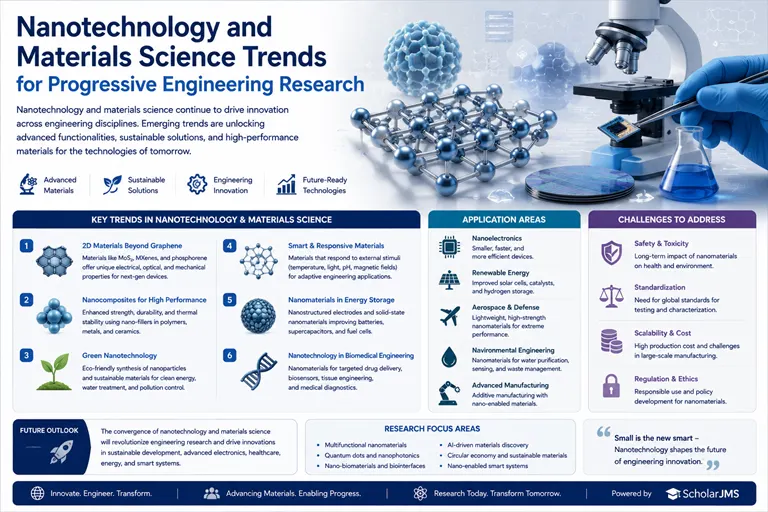
For progressive engineering journals such as the Future Edge Journal of Progressive Research (FEJPR), nanotechnology and materials science represent some of the most dynamic and interdisciplinary research domains, offering immense opportunities for scientific discovery and technological innovation.
This article explores the emerging trends, applications, and future research directions in nanotechnology and materials science that are expected to shape engineering research in 2026 and beyond.
Understanding Nanotechnology and Materials Science
What is Nanotechnology?
Nanotechnology involves the study, manipulation, and application of materials at dimensions ranging from approximately 1 to 100 nanometres. At this scale, materials often exhibit unique physical, chemical, electrical, and biological properties that differ significantly from their bulk counterparts.
Nanotechnology combines knowledge from:
- Physics
- Chemistry
- Materials Engineering
- Biotechnology
- Electronics
- Mechanical Engineering
- Environmental Science
What is Materials Science?
Materials science focuses on understanding the relationship between the structure, properties, processing, and performance of materials. It encompasses:
- Metals and alloys
- Ceramics
- Polymers
- Composite materials
- Biomaterials
- Nanomaterials
- Smart materials
- Functional materials
Modern engineering increasingly relies on advanced materials that are lighter, stronger, more durable, and environmentally sustainable.
Why Nanotechnology Matters in Engineering Research
Nanotechnology has become one of the most influential scientific fields because nanoscale engineering enables researchers to tailor material properties for specific applications.
Key advantages include:
- Higher strength-to-weight ratios
- Enhanced electrical conductivity
- Improved thermal performance
- Superior corrosion resistance
- Increased energy efficiency
- Better biocompatibility
- Enhanced catalytic properties
These characteristics are driving innovation across nearly every engineering discipline.
Emerging Trends in Nanotechnology and Materials Science
1. Graphene and Two-Dimensional Materials
Graphene remains one of the most studied nanomaterials due to its exceptional properties.
Key Characteristics
- Extremely high electrical conductivity
- Outstanding mechanical strength
- Excellent thermal conductivity
- High flexibility
- Lightweight structure
Engineering Applications
- Flexible electronics
- Wearable devices
- Energy storage systems
- Sensors
- Aerospace components
- High-speed transistors
Beyond graphene, researchers are also investigating:
- Borophene
- Phosphorene
- Transition metal dichalcogenides
- Hexagonal boron nitride
These materials have the potential to revolutionize future electronic and energy systems.
2. Smart Materials and Intelligent Structures
Smart materials can respond to external stimuli such as:
- Temperature
- Pressure
- Magnetic fields
- Electrical fields
- Light
- Moisture
Examples
- Shape memory alloys
- Piezoelectric materials
- Magnetostrictive materials
- Self-healing materials
Applications
- Smart bridges
- Aerospace systems
- Medical devices
- Structural health monitoring
- Robotics
- Adaptive manufacturing systems
The integration of smart materials with artificial intelligence is creating new possibilities for intelligent engineering systems.
3. Nanotechnology in Energy Storage
The global transition toward renewable energy has intensified research in advanced materials for energy storage.
Areas of Research
- Lithium-ion batteries
- Solid-state batteries
- Supercapacitors
- Hydrogen storage systems
- Fuel cells
Nanomaterials are being used to improve:
- Energy density
- Charging speed
- Battery life
- Safety
- Thermal stability
Energy storage technologies remain one of the most active research areas in materials science.
4. Sustainable and Green Materials
Sustainability has become a major research priority across engineering disciplines.
Researchers are developing:
- Biodegradable polymers
- Eco-friendly composites
- Green nanomaterials
- Recyclable materials
- Bio-based materials
Research Objectives
- Reduce environmental impact
- Minimize industrial waste
- Lower energy consumption
- Improve resource efficiency
Sustainable materials research aligns with global efforts to achieve environmental and climate goals.
5. Nanomaterials for Environmental Engineering
Environmental engineering increasingly relies on advanced nanomaterials.
Applications
- Water purification
- Air pollution control
- Heavy metal removal
- Wastewater treatment
- Environmental sensors
Nanomaterials such as:
- Carbon nanotubes
- Nanofibers
- Nanocomposites
- Metal oxide nanoparticles
have demonstrated significant potential in environmental remediation technologies.
6. Advanced Biomaterials and Biomedical Engineering
Materials science is playing an increasingly important role in healthcare technologies.
Areas of Research
- Tissue engineering
- Drug delivery systems
- Biomedical implants
- Regenerative medicine
- Biosensors
Nanotechnology enables:
- Targeted drug delivery
- Enhanced biocompatibility
- Improved diagnostic systems
- Personalized medicine
Biomedical materials research represents one of the fastest-growing interdisciplinary areas of engineering.
7. Additive Manufacturing and Advanced Materials
The rapid expansion of additive manufacturing has created demand for new material systems.
Materials Used in 3D Printing
- Metal powders
- Ceramic materials
- Polymer composites
- Nanocomposites
- Biomaterials
Benefits
- Design flexibility
- Reduced manufacturing costs
- Lightweight structures
- Customized components
- Rapid prototyping
The combination of nanotechnology and additive manufacturing is expected to transform industrial production systems.
8. Self-Healing Materials
One of the most fascinating areas of materials science is self-healing technology.
These materials can automatically repair damage caused by:
- Cracks
- Corrosion
- Mechanical stress
- Environmental degradation
Potential applications include:
- Aerospace structures
- Civil infrastructure
- Protective coatings
- Electronic devices
Self-healing materials can significantly reduce maintenance costs and improve system reliability.
9. Nanotechnology for Electronics and Semiconductor Engineering
The semiconductor industry is approaching physical limitations in traditional materials.
Researchers are investigating:
- Quantum materials
- Nanoelectronics
- Flexible electronics
- Spintronics
- Photonic materials
These technologies are expected to influence:
- Artificial Intelligence hardware
- Quantum computing
- High-speed communication systems
- Internet of Things devices
10. Artificial Intelligence in Materials Discovery
Artificial Intelligence is transforming materials research.
Machine learning techniques are now being used to:
- Predict material properties
- Discover new materials
- Optimize manufacturing processes
- Accelerate simulations
- Reduce research costs
The convergence of AI and materials science is creating entirely new research methodologies and accelerating scientific discovery.
Challenges Facing Nanotechnology Research
Despite remarkable progress, several challenges remain.
High Development Costs
Advanced nanomaterials often require expensive equipment and facilities.
Scalability Issues
Many laboratory-scale discoveries are difficult to commercialize.
Safety and Toxicity Concerns
Long-term environmental and health impacts require further investigation.
Regulatory Frameworks
International standards and regulations continue to evolve.
Interdisciplinary Skill Requirements
Modern materials research requires expertise across multiple scientific disciplines.
Addressing these challenges will be essential for the successful adoption of emerging technologies.
Future Research Opportunities
Several areas are expected to dominate future engineering research:
- Quantum materials
- Sustainable nanotechnology
- Nanomedicine
- Smart manufacturing materials
- Energy harvesting materials
- Carbon-neutral material systems
- Autonomous material systems
- Bio-inspired engineering materials
- AI-assisted materials design
- Circular economy materials
These fields offer significant opportunities for researchers, industries, and academic institutions.
Why Nanotechnology Research Needs Interdisciplinary Collaboration
The most impactful discoveries in materials science often occur at the intersection of multiple disciplines.
Successful research projects increasingly involve collaboration among:
- Materials scientists
- Mechanical engineers
- Electrical engineers
- Chemists
- Biomedical researchers
- Data scientists
- Environmental engineers
Engineering journals that encourage interdisciplinary research are likely to become important platforms for future scientific innovation.
Frequently Asked Questions
Why is nanotechnology important in engineering?
Nanotechnology enables the development of materials with unique properties that improve performance, efficiency, and sustainability.
What are nanomaterials?
Nanomaterials are materials with structural components smaller than 100 nanometres that exhibit unique physical and chemical characteristics.
What industries benefit from advanced materials research?
Energy, healthcare, aerospace, electronics, automotive, environmental engineering, and manufacturing industries all benefit significantly.
What is the future of materials science?
Future research will likely focus on smart materials, sustainable materials, AI-assisted discovery, and advanced nanotechnology applications.
Why is interdisciplinary research important in materials science?
Complex engineering challenges often require expertise from multiple scientific and engineering disciplines.
Conclusion
Nanotechnology and materials science are becoming the foundation of next-generation engineering innovation. Their applications span energy systems, healthcare technologies, environmental engineering, electronics, manufacturing, and sustainable development.
As research increasingly moves toward intelligent materials, nanoscale engineering, and interdisciplinary collaboration, these fields will continue to influence the future of progressive engineering research.
The Future Edge Journal of Progressive Research (FEJPR) recognizes the importance of these emerging domains and welcomes high-quality research contributions that advance scientific understanding and technological innovation in nanotechnology, materials science, and related engineering disciplines.
Submit Your Research to FEJPR
Researchers working in:
- Nanotechnology
- Materials Science
- Smart Materials
- Renewable Energy Materials
- Advanced Manufacturing
- Sustainable Engineering
are encouraged to contribute their original research, review articles, and interdisciplinary studies to help shape the future of engineering innovation.