


Sustainable Manufacturing and Green Engineering: Future Research Directions
Sustainable Manufacturing and Green Engineering: Future Research Directions in 2026
The manufacturing sector has been a driving force behind economic development and technological progress for centuries. However, rapid industrialization has also contributed significantly to environmental challenges such as climate change, resource depletion, greenhouse gas emissions, and industrial waste generation.
As governments, industries, and academic institutions increasingly focus on sustainability, the concepts of sustainable manufacturing and green engineering have become central to the future of industrial development. Modern engineering research is no longer limited to improving productivity and profitability alone. It now seeks to balance economic growth with environmental protection and social responsibility.
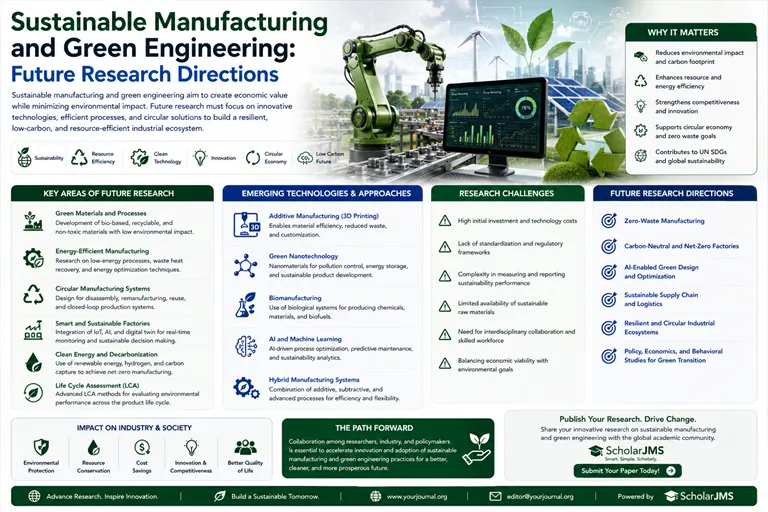
The transition toward sustainable industrial systems is creating exciting opportunities for researchers, engineers, policymakers, and businesses. Technologies such as smart manufacturing, renewable energy integration, circular economy models, artificial intelligence, and advanced materials are reshaping how products are designed, manufactured, and managed throughout their lifecycle.
For journals such as the Future Edge Journal of Progressive Research (FEJPR), sustainable manufacturing and green engineering represent important interdisciplinary research areas with the potential to transform industries and support global sustainability goals.
This article explores emerging trends, challenges, and future research directions that are shaping the next generation of sustainable engineering.
Understanding Sustainable Manufacturing
Sustainable manufacturing refers to the creation of products through economically viable processes that minimize:
- Environmental impacts
- Energy consumption
- Material waste
- Greenhouse gas emissions
- Occupational hazards
- Resource depletion
The objective is to create manufacturing systems that remain productive while preserving natural resources and protecting future generations.
Core Principles of Sustainable Manufacturing
- Efficient use of resources
- Pollution prevention
- Waste minimization
- Renewable energy utilization
- Product lifecycle management
- Environmental responsibility
- Economic sustainability
- Social well-being
Modern manufacturing systems increasingly incorporate these principles into their strategic planning and operational practices.
What is Green Engineering?
Green engineering involves designing products, systems, and processes that minimize environmental impacts throughout their entire lifecycle.
Green engineering emphasizes:
- Energy efficiency
- Resource conservation
- Sustainable materials
- Pollution prevention
- Eco-friendly technologies
- Circular production systems
Rather than addressing environmental problems after they occur, green engineering focuses on preventing them during the design stage.
Why Sustainable Manufacturing Matters
The industrial sector consumes enormous quantities of:
- Energy
- Water
- Raw materials
- Fossil fuels
At the same time, manufacturing contributes significantly to:
- Carbon emissions
- Air pollution
- Industrial waste
- Water contamination
Sustainable manufacturing helps industries:
- Reduce operational costs
- Improve efficiency
- Enhance competitiveness
- Meet environmental regulations
- Improve corporate reputation
- Support climate goals
Consequently, sustainability has become a strategic priority across industries worldwide.
Major Trends Driving Green Engineering Research
1. Circular Economy and Closed-Loop Manufacturing
One of the most influential developments in modern manufacturing is the transition from linear production systems toward circular economies.
Traditional manufacturing follows:
Take → Make → Use → Dispose
Circular manufacturing follows:
Design → Produce → Use → Reuse → Recycle → Recover
Research Areas
- Product remanufacturing
- Material recovery
- Recycling technologies
- Design for disassembly
- Waste-to-resource systems
- Sustainable supply chains
Circular economy research is expected to become one of the most important themes in future engineering studies.
2. Industry 5.0 and Human-Centric Manufacturing
Industry 4.0 introduced automation, digitalization, and intelligent systems.
Industry 5.0 expands this vision by emphasizing:
- Human-machine collaboration
- Sustainability
- Resilience
- Personalization
- Social responsibility
Researchers are exploring how advanced technologies can support sustainable production while maintaining human well-being and economic efficiency.
3. Smart Manufacturing and Artificial Intelligence
Artificial Intelligence is revolutionizing manufacturing operations.
Applications Include
- Predictive maintenance
- Process optimization
- Quality control
- Energy management
- Demand forecasting
- Resource planning
AI-driven manufacturing systems help organizations:
- Reduce waste
- Improve productivity
- Lower energy consumption
- Increase operational efficiency
4. Renewable Energy Integration
Manufacturing facilities increasingly integrate renewable energy sources such as:
- Solar energy
- Wind energy
- Biomass
- Hydrogen technologies
Research focuses on:
- Energy storage systems
- Smart grids
- Microgrids
- Carbon-neutral manufacturing
Renewable energy integration will remain a major research area over the coming decades.
5. Sustainable Materials and Green Composites
Materials engineering plays an essential role in sustainable manufacturing.
Researchers are investigating:
- Biodegradable polymers
- Green composites
- Bio-based materials
- Recycled materials
- Low-carbon materials
- Nanomaterials
The development of sustainable materials can significantly reduce environmental impacts across industries.
6. Additive Manufacturing and Resource Efficiency
Additive manufacturing or 3D printing has emerged as an important green manufacturing technology.
Advantages Include
- Reduced material waste
- Lower transportation requirements
- Customized production
- Energy-efficient manufacturing
- Distributed manufacturing systems
Researchers continue to investigate sustainable materials and energy-efficient printing technologies.
7. Digital Twins and Sustainable Manufacturing
Digital twins create virtual replicas of manufacturing systems.
They enable engineers to:
- Monitor processes
- Optimize energy usage
- Predict failures
- Improve maintenance planning
- Simulate environmental impacts
Digital twin technologies support more intelligent and sustainable industrial operations.
8. Green Supply Chain Management
Manufacturing sustainability extends beyond factory operations.
Modern research increasingly focuses on:
- Sustainable logistics
- Green procurement
- Carbon footprint reduction
- Sustainable transportation
- Supplier sustainability assessment
Green supply chain management has become a critical component of industrial sustainability strategies.
9. Water Conservation and Waste Management
Industrial water usage continues to rise globally.
Researchers are exploring:
- Wastewater recycling
- Zero-liquid-discharge systems
- Industrial symbiosis
- Water-efficient technologies
- Circular water management systems
Effective water management will remain an essential aspect of future manufacturing sustainability.
10. Carbon Neutral Manufacturing Systems
Many organizations have announced ambitious net-zero targets.
Engineering researchers are investigating:
- Carbon capture technologies
- Energy-efficient manufacturing
- Carbon accounting methods
- Sustainable process design
- Emission reduction strategies
The transition toward carbon-neutral industries is likely to generate significant research opportunities.
Emerging Research Areas in Sustainable Manufacturing
Several rapidly growing research domains are attracting considerable attention.
Sustainable Smart Factories
Factories that combine:
- Automation
- Artificial Intelligence
- Renewable energy
- Digital twins
- Resource optimization
Green Robotics
Robotics systems designed to:
- Improve energy efficiency
- Reduce waste
- Optimize production processes
Sustainable Electronics Manufacturing
Research areas include:
- Green semiconductors
- Electronic waste recycling
- Low-energy devices
Bio-Inspired Manufacturing Systems
Nature-inspired engineering solutions for:
- Material efficiency
- Structural optimization
- Energy conservation
Challenges Facing Green Manufacturing
Despite significant progress, several challenges remain.
High Initial Investment
Implementing sustainable technologies often requires substantial capital.
Technology Adoption Barriers
Many industries face challenges related to:
- Technical expertise
- Infrastructure limitations
- Organizational resistance
Supply Chain Complexity
Achieving sustainability across entire supply chains remains difficult.
Data Availability
Measuring sustainability performance requires reliable data and monitoring systems.
Regulatory Uncertainty
Environmental regulations continue to evolve globally.
Addressing these challenges requires collaboration between researchers, industries, and policymakers.
Future Research Directions
Several research areas are expected to dominate future engineering investigations.
Artificial Intelligence for Sustainability
Using machine learning to optimize manufacturing processes and reduce environmental impacts.
Circular Economy Analytics
Developing models that improve material recovery and resource efficiency.
Hydrogen-Based Manufacturing Systems
Exploring hydrogen as a clean industrial energy source.
Sustainable Nanomaterials
Developing environmentally friendly advanced materials.
Carbon Capture Technologies
Designing systems that reduce industrial emissions.
Smart Energy Management Systems
Integrating renewable energy with intelligent industrial systems.
Sustainable Product Lifecycle Engineering
Considering environmental impacts throughout the entire product lifecycle.
Green Digital Manufacturing
Combining digital technologies with sustainability objectives.
These research directions provide exciting opportunities for engineers and researchers worldwide.
The Role of Interdisciplinary Research
Sustainable manufacturing cannot be addressed through a single discipline.
Meaningful progress requires collaboration among:
- Mechanical Engineers
- Electrical Engineers
- Environmental Scientists
- Materials Engineers
- Computer Scientists
- Economists
- Industrial Engineers
- Policy Experts
Interdisciplinary research will play a crucial role in solving future sustainability challenges.
Why Sustainable Manufacturing Research Matters for Engineering Journals
The growing importance of sustainability has created demand for high-quality scholarly platforms that publish innovative engineering solutions.
Research in:
- Green technologies
- Circular economy
- Renewable energy
- Smart manufacturing
- Sustainable materials
- Industrial sustainability
is expected to increase significantly over the coming decade.
Engineering journals that encourage interdisciplinary sustainability research can make valuable contributions to global scientific and technological progress.
Frequently Asked Questions
What is sustainable manufacturing?
Sustainable manufacturing involves producing goods using processes that minimize environmental impacts while maintaining economic and social benefits.
What is green engineering?
Green engineering focuses on designing products and systems that prevent pollution and conserve resources throughout their lifecycle.
Why is the circular economy important?
The circular economy promotes resource efficiency through reuse, recycling, and recovery of materials.
How does Industry 5.0 support sustainability?
Industry 5.0 combines advanced technologies with human-centered and sustainable manufacturing approaches.
What are the major research opportunities in green engineering?
Artificial intelligence, renewable energy, smart factories, sustainable materials, and carbon-neutral manufacturing are among the leading research areas.
Conclusion
Sustainable manufacturing and green engineering are rapidly becoming essential pillars of industrial development and engineering innovation. Advances in artificial intelligence, renewable energy, circular economy models, digital manufacturing, and sustainable materials are transforming how industries operate and compete.
As environmental challenges continue to intensify, researchers and engineers have a critical responsibility to develop technologies and manufacturing systems that balance economic growth with environmental stewardship.
The Future Edge Journal of Progressive Research (FEJPR) recognizes the importance of sustainability-driven engineering research and welcomes original contributions that address emerging challenges and opportunities in sustainable manufacturing, green technologies, and environmental engineering.
Submit Your Research to FEJPR
Researchers working in:
- Sustainable Manufacturing
- Green Engineering
- Renewable Energy Systems
- Circular Economy
- Smart Manufacturing
- Sustainable Materials
- Industrial Sustainability
- Environmental Technologies
are encouraged to submit their original research, review articles, and interdisciplinary studies to contribute toward building a more sustainable industrial future.