


How to Get ISSN and Crossref DOI for a New Engineering Journal
How to Get ISSN and Crossref DOI for a New Engineering Journal: A Complete Guide for Editors and Publishers
The number of engineering journals being launched by universities, professional societies, research institutions, and independent publishers has grown significantly in recent years. New journals are emerging in areas such as artificial intelligence, renewable energy, electric vehicles, materials science, smart manufacturing, and interdisciplinary engineering research.
However, many new journal founders quickly discover that establishing a credible scholarly journal involves more than publishing articles online. Two of the most important milestones in building a professional journal are obtaining an ISSN (International Standard Serial Number) and implementing Crossref DOI (Digital Object Identifier) registration.
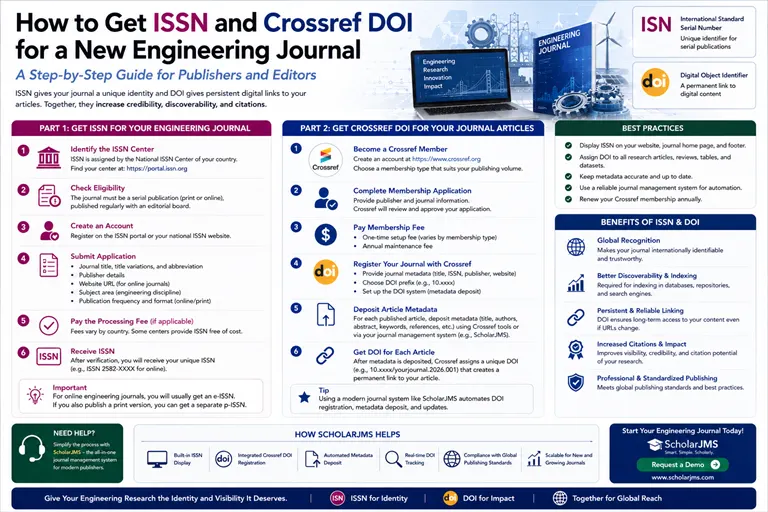
Both ISSN and DOI play essential roles in journal visibility, discoverability, citation management, and indexing readiness. Journals that plan these aspects properly from the beginning often build stronger publishing foundations and gain greater trust among authors and readers.
The experience of journals such as the Future Edge Journal of Progressive Research (FEJPR) demonstrates the importance of building a professionally managed publishing infrastructure with proper identifiers and metadata standards. FEJPR operates as an online, peer-reviewed, open-access engineering journal with an e-ISSN and modern journal management platform.
This guide explains how editors and publishers can obtain ISSN and Crossref DOI for a new engineering journal.
Why ISSN and DOI Matter for Engineering Journals
Many new journals underestimate the importance of publishing identifiers.
However, these identifiers provide significant benefits.
Benefits of ISSN
- Global journal identification
- Increased credibility
- Better discoverability
- Library cataloguing
- Support for indexing applications
- Professional journal recognition
Benefits of DOI
- Permanent article identification
- Citation tracking
- Long-term accessibility
- Better metadata management
- Enhanced discoverability
- Integration with scholarly databases
Modern scholarly publishing increasingly expects journals to implement both identifiers as part of their publication infrastructure.
What is an ISSN?
ISSN stands for International Standard Serial Number.
It is an eight-digit identification number assigned to serial publications such as:
- Academic journals
- Magazines
- Continuing resources
- Electronic journals
- Print journals
An ISSN identifies the journal itself rather than individual articles.
For example, FEJPR publishes online and has been assigned an electronic ISSN, helping establish its identity as a scholarly publication.
Why Every New Engineering Journal Needs an ISSN
An ISSN helps journals:
Establish Legitimacy
Authors and readers generally view journals with official identifiers as more credible.
Improve Discoverability
Libraries and databases use ISSNs to identify and manage journals.
Prepare for Indexing
Many indexing services request ISSN information during evaluation.
Facilitate Citation and Metadata Management
ISSN improves standardization across publishing platforms.
Step-by-Step Process to Obtain an ISSN
Step 1: Develop a Professional Journal Website
Before applying for ISSN, your journal should have:
- Journal title
- About page
- Aim and scope
- Editorial board
- Author guidelines
- Publication ethics
- Contact information
- Publication policies
- Submission system
A professionally developed journal website significantly improves ISSN readiness.
Step 2: Define Publication Details
Prepare information including:
- Journal title
- Short title
- Publication frequency
- Publisher information
- Subject area
- Publication language
- Journal URL
Step 3: Prepare Editorial Information
Your journal should clearly display:
- Editor-in-Chief
- Editorial Board
- Publisher details
- Contact information
- Peer review policy
Transparency is increasingly important in scholarly publishing.
Step 4: Prepare Sample Content
Many ISSN agencies prefer journals to demonstrate publishing readiness through:
- Sample issues
- Published articles
- Publication plans
- Submission guidelines
Step 5: Submit the ISSN Application
Applications are generally reviewed by the relevant national ISSN centre.
The review process often evaluates:
- Website completeness
- Publishing policies
- Journal legitimacy
- Editorial information
- Publication readiness
The exact requirements may vary depending on the country and publication format.
Common Reasons ISSN Applications Are Delayed
Many new journals experience delays because of:
- Incomplete websites
- Missing editorial information
- Poor publishing policies
- Lack of publication plans
- Unclear journal scope
- Missing contact details
Proper preparation can significantly improve the application process.
ISSN Readiness Checklist
| Requirement | Status |
|---|---|
| Journal Website | Essential |
| Editorial Board | Essential |
| Publication Policies | Essential |
| Author Guidelines | Essential |
| Peer Review Policy | Essential |
| Contact Information | Essential |
| Publication Frequency | Essential |
| Sample Content | Recommended |
Need Help with ISSN Consulting?
Launching a new journal can be complex.
Professional support can assist with:
- Journal website readiness
- ISSN consulting
- Publishing policies
- Editorial workflows
- Journal launch planning
Platforms such as OJSCloud provide support services for journals seeking assistance with journal establishment and publishing infrastructure.
We can help with:
- ISSN consulting
- Journal website setup
- Publishing readiness
- Editorial workflows
- Journal launch support
WhatsApp: +91 82003 85143
Direct WhatsApp: https://wa.me/918200385143
Email: inquiry@ojscloud.com
What is a Crossref DOI?
DOI stands for Digital Object Identifier.
A DOI is a permanent and unique identifier assigned to scholarly content such as:
- Journal articles
- Review papers
- Conference proceedings
- Datasets
- Book chapters
Unlike URLs, DOIs remain persistent even if website structures change.
Why Engineering Journals Need DOI Registration
Engineering research often has long citation lifecycles.
DOIs provide:
- Permanent access
- Citation linking
- Better discoverability
- Metadata integration
- International publishing standards
- Increased trust among researchers
Many authors prefer publishing in journals that provide DOI-enabled articles.
What is Crossref?
Crossref is one of the world's leading DOI registration agencies for scholarly publishing.
Crossref supports:
- DOI registration
- Metadata management
- Citation linking
- Reference matching
- Research infrastructure services
Millions of scholarly publications rely on Crossref DOI services worldwide.
How to Get Crossref DOI for Your Journal
Step 1: Prepare Your Journal Website
Your journal should already have:
- ISSN
- Published articles
- Metadata standards
- Article landing pages
- Editorial policies
Step 2: Establish DOI Workflows
A DOI workflow typically includes:
- Article metadata preparation
- DOI assignment
- Metadata deposits
- DOI maintenance
Step 3: Register Article Metadata
Metadata generally includes:
- Article title
- Author information
- Abstract
- Publication date
- References
- Journal information
Accurate metadata significantly improves discoverability.
Step 4: Deposit DOI Metadata
After metadata preparation, DOI records are deposited and become part of the global scholarly infrastructure.
Why DOI Planning Should Start Early
Many journals wait until they publish several issues before considering DOI implementation.
This often creates challenges such as:
- Metadata inconsistencies
- Workflow complications
- Article corrections
- Administrative burdens
Planning DOI workflows from the beginning leads to smoother journal operations.
Common DOI Mistakes Made by New Journals
Delaying DOI Implementation
Late implementation creates unnecessary work.
Poor Metadata Quality
Incomplete metadata reduces discoverability.
Inconsistent DOI Structures
A clear DOI policy should be established early.
Lack of Workflow Planning
Editorial teams should understand DOI management procedures.
GetDOI Support for Engineering Journals
Many new journals require guidance regarding:
- Crossref membership
- DOI workflows
- Metadata preparation
- Technical implementation
- DOI assignment strategies
Services such as GetDOI provide assistance with:
- DOI setup
- Crossref workflows
- Metadata support
- Publishing consultation
Need Help with DOI Registration?
We can assist with:
- Crossref DOI support
- Metadata management
- DOI workflow planning
- Publishing guidance
WhatsApp: +91 82003 85143
Direct WhatsApp: https://wa.me/918200385143
Email: inquiry@ojscloud.com
Why Journal Management Systems Matter
Modern publishing infrastructure can simplify both ISSN and DOI implementation.
Platforms such as ScholarJMS help journals manage:
- Journal websites
- Manuscript submissions
- Editorial workflows
- Publication management
- DOI-ready article structures
- Metadata organization
A professionally managed platform reduces administrative complexity and improves long-term sustainability.
ISSN and DOI Checklist for New Engineering Journals
| Activity | Recommended Status |
| Journal Website | Essential |
| Editorial Board | Essential |
| Publication Policies | Essential |
| ISSN Application | Essential |
| Published Articles | Recommended |
| DOI Planning | Essential |
| Metadata Standards | Essential |
| Editorial Workflow | Essential |
| Long-Term Archiving | Recommended |
Frequently Asked Questions
Can a journal get DOI without ISSN?
Some DOI workflows may technically be possible, but obtaining an ISSN first is generally recommended for professional journal publishing.
Is ISSN mandatory for an online journal?
An ISSN is strongly recommended because it improves credibility and discoverability.
How long does ISSN approval take?
The review period varies by country and publishing readiness.
Is DOI mandatory?
No, but DOI implementation significantly improves journal professionalism and visibility.
Can a new journal immediately register DOIs?
Yes, provided the journal has established appropriate publishing workflows and infrastructure.
Why do authors prefer DOI-enabled journals?
DOIs provide permanent links, improve citation tracking, and enhance trust in scholarly publications.
Conclusion
Obtaining an ISSN and implementing Crossref DOI are among the most important milestones in establishing a professional engineering journal.
ISSN provides the journal with a globally recognized identity, while DOI enables persistent article identification and better integration into the scholarly communication ecosystem.
Journals that plan these processes carefully from the beginning are better positioned for long-term growth, discoverability, and indexing readiness.
The Future Edge Journal of Progressive Research (FEJPR) demonstrates how a professionally managed journal infrastructure, supported by clear publication standards and modern publishing systems, can help establish a credible platform for engineering research.
Need Help Launching or Upgrading Your Journal?
We can help with:
- Journal website development
- ScholarJMS setup
- ISSN consulting
- Crossref DOI support
- Editorial workflow implementation
- OJS migration
- Journal launch guidance
WhatsApp: +91 82003 85143
Direct WhatsApp: https://wa.me/918200385143
Email: inquiry@ojscloud.com