

OJS vs ScholarJMS: Which Platform Is Better for New Engineering Journals?
OJS vs ScholarJMS: Which Platform Is Better for New Engineering Journals in 2026?
Launching a new engineering journal involves much more than publishing articles online. Modern scholarly publishing requires a professional website, efficient manuscript submission workflows, transparent peer review processes, DOI integration, indexing readiness, and a positive experience for authors, reviewers, and editors.
One of the most important decisions that journal founders must make is choosing the right journal management platform.
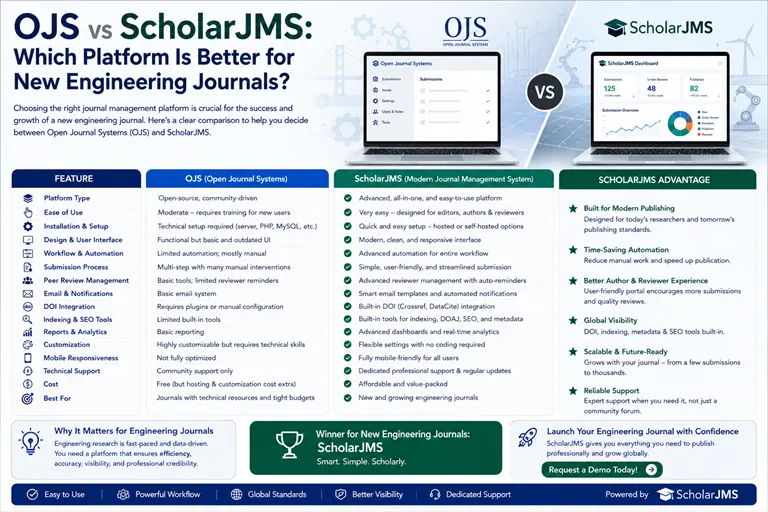
For many years, Open Journal Systems (OJS) has been one of the most widely used journal management solutions in academic publishing. However, the publishing landscape is evolving rapidly, and many journals now seek more modern, user-friendly, and fully managed alternatives such as ScholarJMS.
For new engineering journals, the choice of platform can significantly influence operational efficiency, author satisfaction, and long-term sustainability.
This article compares OJS and ScholarJMS to help journal owners, editors, and institutions determine which solution best suits their publishing needs.
Understanding OJS and ScholarJMS
What is OJS?
Open Journal Systems (OJS) is an open-source journal management platform developed to support scholarly publishing workflows.
OJS provides tools for:
- Manuscript submission
- Peer review management
- Editorial workflows
- Article publication
- Issue management
- Basic metadata management
Because it is open-source, OJS is widely adopted by universities, libraries, and academic societies.
However, successful implementation often requires technical expertise, hosting management, maintenance, upgrades, and customization.
What is ScholarJMS?
ScholarJMS is a modern journal website and manuscript management platform designed specifically for scholarly publishers, journals, academic institutions, and research organizations.
The platform provides:
- Journal website development
- Online manuscript submission
- Editorial workflow management
- Peer review automation
- Article publishing infrastructure
- DOI-ready workflows
- Modern user interfaces
- Technical support and maintenance
ScholarJMS aims to simplify journal management by offering an integrated and professionally managed publishing ecosystem.
Why Engineering Journals Have Special Requirements
Engineering journals often handle:
- Large manuscript files
- Technical drawings
- Simulation datasets
- Source code files
- Supplementary materials
- Complex review workflows
- Multidisciplinary submissions
As submission volumes grow, journals require systems that are reliable, scalable, and easy to administer.
The right publishing platform can substantially reduce editorial workload while improving the experience for authors and reviewers.
OJS vs ScholarJMS: Detailed Comparison
| Feature | OJS | ScholarJMS |
|---|---|---|
| Open Source | Yes | No |
| Managed Hosting | Optional | Included |
| Technical Support | Depends on provider | Dedicated support |
| Website Design | Requires customization | Modern ready-to-use designs |
| Setup Complexity | Moderate to High | Low |
| Maintenance Responsibility | Journal owner | Managed by platform |
| Software Updates | Manual | Managed |
| Editorial Workflow | Good | Advanced and simplified |
| DOI Integration | Available with configuration | Workflow-ready |
| Mobile Responsiveness | Theme dependent | Optimized |
| Performance Optimization | Depends on hosting | Managed |
| OJS Migration Support | Not applicable | Available |
| User Experience | Functional | Modern and intuitive |
Website Development and User Experience
OJS
Many journals appreciate OJS because it is flexible and open-source. However, creating a modern-looking journal website often requires:
- Theme customization
- Developer support
- Technical maintenance
- Plugin configuration
Some institutions may find these requirements challenging.
ScholarJMS
ScholarJMS provides professionally designed journal websites that are optimized for:
- User experience
- Mobile accessibility
- Editorial workflows
- Author engagement
- Search engine visibility
For new engineering journals without dedicated technical teams, this can significantly reduce implementation challenges.
Manuscript Submission Experience
OJS
OJS offers robust submission functionality but may require user training and interface customization.
New authors occasionally find certain workflows complex, especially when journals use heavily customized installations.
ScholarJMS
ScholarJMS emphasizes:
- Simpler submissions
- Cleaner interfaces
- Faster navigation
- Reduced administrative complexity
A positive submission experience can improve author satisfaction and encourage repeat submissions.
Editorial Workflow Management
Engineering journals often manage:
- Multiple reviewers
- Technical revisions
- Supplementary files
- Interdisciplinary submissions
OJS
Provides comprehensive workflow capabilities but may require administrative expertise to configure and maintain effectively.
ScholarJMS
Provides workflow automation that helps editors:
- Track submissions
- Monitor reviewer progress
- Manage communications
- Publish articles efficiently
This reduces manual administrative work and allows editors to focus on publication quality.
Peer Review Management
Efficient peer review remains the foundation of scholarly publishing.
OJS
Supports:
- Single-blind review
- Double-blind review
- Editorial decision workflows
However, customization may be needed depending on journal requirements.
ScholarJMS
Provides:
- Reviewer assignment workflows
- Automated notifications
- Status tracking
- Communication tools
- Simplified editorial management
Modern workflows can improve reviewer engagement and reduce publication delays.
Hosting and Technical Management
One of the biggest differences between OJS and ScholarJMS lies in technical responsibilities.
OJS
Journals typically need to manage:
- Hosting
- Security updates
- Server maintenance
- Backups
- Software upgrades
- Technical troubleshooting
This often requires technical expertise or external service providers.
ScholarJMS
Technical management is handled within the platform ecosystem, reducing operational burdens on editors and publishers.
Why Many Journals Seek OJS Support Services
Although OJS remains widely used, many journals require assistance with:
- OJS hosting
- OJS installation
- Security updates
- Technical support
- Version upgrades
- Workflow optimization
- Journal migration
This has created demand for specialized publishing service providers.
OJSCloud Support Services
Publishing support providers such as OJSCloud help journals with:
- OJS hosting
- OJS technical support
- OJS upgrades
- Journal launch consulting
- ISSN consulting
- Website development
- Journal migration services
Need Help with OJS Hosting or Journal Setup?
We can assist with:
- OJS hosting and support
- Journal website development
- ISSN consulting
- Editorial workflow setup
- OJS migration services
- Publishing consultation
WhatsApp: +91 82003 85143
Email: inquiry@ojscloud.com
DOI Integration and Publishing Workflows
Digital Object Identifiers (DOIs) are increasingly important for journal visibility and citation management.
Both platforms can support DOI workflows, but implementation approaches may differ.
Professional support can simplify:
- Crossref membership guidance
- Metadata preparation
- DOI assignment workflows
- Technical integration
Services such as GetDOI assist journals with DOI planning and implementation.
Need Help with Crossref DOI Setup?
We provide support for:
- Crossref DOI implementation
- Metadata preparation
- DOI workflow setup
- Publishing consultation
WhatsApp: +91 82003 85143
Email: inquiry@ojscloud.com
Indexing Readiness
Modern journal platforms should help journals prepare for:
- Google Scholar indexing
- Metadata quality
- Publication consistency
- Search engine visibility
- Long-term archiving
A professional publishing infrastructure supports future indexing objectives and improves discoverability.
Cost Considerations
OJS
The software itself is open-source, but journals may still incur costs for:
- Hosting
- Development
- Technical support
- Maintenance
- Security management
- Customization
ScholarJMS
ScholarJMS generally provides an integrated environment that combines multiple services into a single publishing ecosystem, potentially reducing the need for separate technical resources.
When evaluating costs, journals should consider the total cost of ownership rather than software licensing alone.
Which Platform Is Better for New Engineering Journals?
The answer depends on the journal's requirements.
OJS May Be Suitable If:
- Your institution has technical expertise.
- You prefer open-source software.
- You require extensive customization.
- You can manage hosting and maintenance.
ScholarJMS May Be Suitable If:
- You want a professionally managed platform.
- You prefer minimal technical responsibilities.
- You need a modern user experience.
- You want faster implementation.
- You require workflow support and publishing guidance.
Both platforms can successfully support scholarly publishing when implemented appropriately.
Why Modern Publishing Infrastructure Matters
Engineering research is becoming increasingly competitive and international.
Authors expect:
- Professional websites
- Efficient submissions
- Transparent workflows
- Faster communication
- Better digital experiences
A journal's publishing platform is no longer merely an administrative tool. It has become a strategic component of journal growth and reputation.
Frequently Asked Questions
Is OJS free?
Yes. OJS is open-source software, although journals may still incur costs for hosting, customization, and technical support.
Is ScholarJMS suitable for new journals?
ScholarJMS is designed to simplify journal management and may be particularly useful for new or growing journals seeking a managed solution.
Can journals migrate from OJS to ScholarJMS?
Yes. Journal migration services can assist with content and workflow transitions.
Which platform is easier for editors?
Ease of use depends on individual preferences and technical experience, but many publishers prefer modern interfaces that reduce administrative complexity.
Do both systems support DOI workflows?
Yes. Both systems can support DOI management with appropriate configuration and implementation.
Which platform is better for engineering journals?
The ideal choice depends on the journal's technical resources, workflow requirements, and long-term publishing strategy.
Conclusion
Choosing a journal management platform is one of the most important decisions for any new engineering journal.
OJS remains a powerful and widely respected open-source publishing solution, particularly for institutions with technical expertise and customization requirements.
At the same time, platforms such as ScholarJMS provide a modern, professionally managed environment that reduces technical complexity and allows editors to focus on scholarly quality and journal growth.
For emerging engineering journals seeking efficient workflows, modern user experiences, and comprehensive publishing support, evaluating both platforms carefully can help build a strong foundation for long-term success.
The Future Edge Journal of Progressive Research (FEJPR) recognizes the importance of modern publishing technologies and encourages journals to adopt digital infrastructures that support high-quality scholarly communication and sustainable growth.
Need Help Launching or Upgrading Your Journal?
We can help with:
- ScholarJMS journal website setup
- OJS hosting and support
- OJS to ScholarJMS migration
- ISSN consulting
- Crossref DOI support
- Editorial workflow implementation
- Journal launch guidance
WhatsApp: +91 82003 85143
Direct WhatsApp: https://wa.me/918200385143
Email: inquiry@ojscloud.com