


How to Migrate an OJS Engineering Journal to a Modern Journal Management Platform
How to Migrate an OJS Engineering Journal to a Modern Journal Management Platform: A Complete Guide for Editors and Publishers
Over the past two decades, Open Journal Systems (OJS) has played a significant role in supporting scholarly publishing worldwide. Thousands of engineering journals, university publications, and academic societies continue to use OJS because of its flexibility and open-source foundation.
However, the expectations of authors, reviewers, and editors have changed considerably. Modern scholarly publishing now demands faster workflows, mobile-friendly interfaces, integrated publishing tools, better user experiences, and simplified journal administration.
As engineering research continues to expand globally, many journal owners and publishers are evaluating whether their current publishing infrastructure is sufficient to support future growth.
For many journals, the answer is modernization.
Increasingly, engineering journals are migrating from older systems to modern journal management platforms that offer enhanced usability, integrated workflows, and reduced technical complexity.
This guide explains how engineering journals can successfully migrate from OJS to a modern publishing platform while preserving their content, metadata, and scholarly reputation.
Why Engineering Journals Consider Migration
Many journals initially choose OJS because it is open-source and highly customizable. However, as journals grow, editors often encounter operational challenges that encourage them to explore alternative solutions.
Common reasons for migration include:
- Complex administration
- Outdated user experience
- Technical maintenance burdens
- Performance issues
- Limited technical resources
- Difficulty managing upgrades
- Need for modern workflows
- Requirement for better author experiences
- Website redesign requirements
- Desire for integrated publishing services
Migration is often part of a journal's long-term strategy for improving efficiency and sustainability.
Signs That Your Journal May Need Modernization
1. Editorial Teams Spend Too Much Time on Administration
If editors spend more time managing technology than managing research quality, modernization may be necessary.
2. Authors Find Submission Difficult
Complicated submission experiences can discourage future submissions.
3. Frequent Technical Problems
Recurring issues related to:
- Hosting
- Security
- Plugins
- Performance
- Upgrades
may indicate that the platform requires modernization.
4. Website Design Appears Outdated
A journal's website significantly influences author perception and journal credibility.
5. Growth Has Outpaced Existing Infrastructure
As submission volumes increase, older systems can become increasingly difficult to manage efficiently.
Benefits of Migrating to a Modern Journal Management Platform
Modern publishing platforms provide numerous advantages.
Improved User Experience
- Mobile-friendly interfaces
- Simplified submissions
- Faster navigation
- Better accessibility
Enhanced Editorial Workflows
- Automated communications
- Reviewer management
- Status tracking
- Workflow monitoring
Reduced Technical Burden
- Managed hosting
- Software maintenance
- Security updates
- Technical support
Better Publishing Infrastructure
- DOI-ready workflows
- Metadata management
- Search engine optimization
- Integrated publishing tools
Improved Scalability
Modern systems are designed to support journal growth and increasing submission volumes.
Common Concerns Before Migration
Many journal owners hesitate to migrate because they worry about losing:
- Published articles
- Metadata
- DOI links
- Indexing visibility
- Submission records
- Archives
- Website traffic
Fortunately, a well-planned migration can preserve all critical publishing assets.
What Should Be Migrated?
A successful migration usually includes:
Journal Website Content
- Home page
- About Journal
- Editorial Board
- Author Guidelines
- Publication Ethics
- Contact pages
Published Articles
- Current issues
- Archives
- PDFs
- Supplementary files
Metadata
- Titles
- Authors
- Abstracts
- Keywords
- References
- DOI information
Editorial Data
- User accounts
- Reviewer information
- Submission histories
Careful planning ensures continuity and minimizes disruptions.
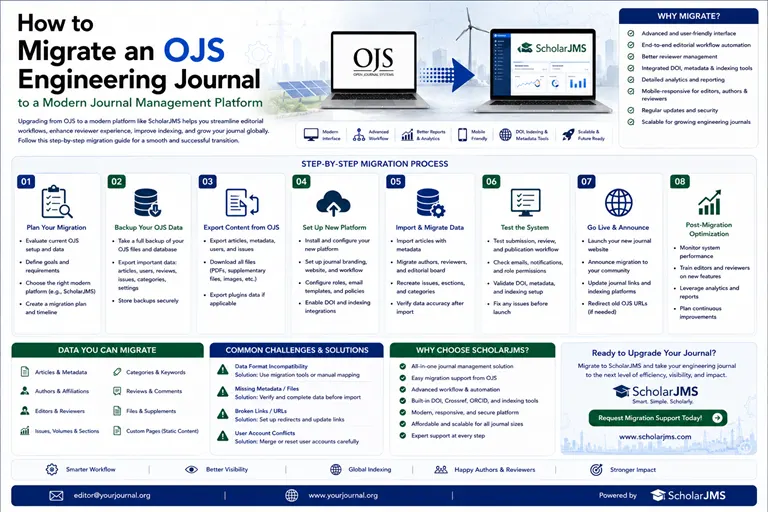
Step-by-Step OJS Migration Process
Step 1: Conduct a Migration Assessment
Before migrating, evaluate:
- Number of issues
- Number of articles
- DOI status
- User accounts
- Website complexity
- Custom features
A detailed assessment helps determine the migration strategy.
Step 2: Back Up Everything
Always create complete backups of:
- Databases
- Files
- Article archives
- Images
- Configuration files
Backups are essential for minimizing risk.
Step 3: Audit Journal Metadata
Metadata quality directly influences discoverability.
Review:
- Article titles
- Author information
- Abstracts
- Keywords
- References
- DOI assignments
Migration presents an excellent opportunity to improve metadata quality.
Step 4: Plan Website Redesign
Many journals use migration as an opportunity to modernize their websites.
Important considerations include:
- Mobile responsiveness
- Accessibility
- Navigation
- Search engine optimization
- Branding consistency
A modern website improves both usability and journal reputation.
Step 5: Migrate Content and Archives
Migration generally includes:
- Issues
- Articles
- PDFs
- Supplementary files
- Metadata
- Images
Proper testing is essential before public launch.
Step 6: Preserve DOI Integrity
One of the most important aspects of migration is maintaining DOI functionality.
DOIs should continue to:
- Resolve correctly
- Direct users to article pages
- Maintain metadata consistency
- Preserve citation links
Poor DOI management can negatively affect discoverability and citations.
Why DOI Planning Matters During Migration
Many journals underestimate the importance of DOI preservation.
Modern migration projects should include:
- DOI verification
- Metadata review
- URL updates
- Crossref consistency checks
Professional support services such as GetDOI can help journals manage DOI workflows and preserve publishing integrity during migration.
Need Help with DOI Management During Migration?
We can assist with:
- DOI verification
- Metadata updates
- Crossref support
- Publishing consultation
WhatsApp: +91 82003 85143
Email: inquiry@ojscloud.com
Step 7: Test Editorial Workflows
Before launching the new system, test:
- Manuscript submission
- Reviewer assignment
- Editorial decisions
- Email notifications
- User registrations
- Publishing workflows
Comprehensive testing minimizes post-migration issues.
Step 8: Train Editors and Staff
Modern platforms often introduce new workflows.
Training should cover:
- Submission management
- Reviewer workflows
- Article publishing
- Metadata management
- Reporting tools
Well-trained editorial teams adapt more quickly to new systems.
Why Many Engineering Journals Choose Managed Platforms
Many journals prefer to focus on:
- Research quality
- Editorial development
- Author engagement
- Publication growth
rather than:
- Software maintenance
- Security updates
- Server administration
- Technical troubleshooting
Managed publishing platforms help journals reduce operational burdens and improve efficiency.
ScholarJMS: A Modern Publishing Solution
Modern journal platforms such as ScholarJMS provide:
- Journal website development
- Manuscript submission systems
- Editorial workflow automation
- DOI-ready publishing infrastructure
- Archive management
- Technical support
- Modern user interfaces
These capabilities are particularly beneficial for engineering journals seeking scalable and professionally managed publishing environments.
OJSCloud Migration Support Services
Migration projects often require specialized expertise.
Publishing service providers such as OJSCloud assist journals with:
- OJS hosting
- OJS upgrades
- Journal migration
- Website redesign
- ISSN consulting
- Editorial workflow optimization
- Technical support
Need Help Migrating Your Journal?
We can help with:
- OJS to ScholarJMS migration
- OJS hosting and support
- Journal website redesign
- Metadata migration
- ISSN consulting
- Editorial workflow setup
WhatsApp: +91 82003 85143
Direct WhatsApp: https://wa.me/918200385143
Email: inquiry@ojscloud.com
Common Migration Mistakes to Avoid
Migrating Without Backups
Always create complete backups.
Ignoring Metadata Quality
Poor metadata can affect discoverability.
Breaking DOI Links
DOI preservation should be a priority.
Skipping Workflow Testing
Testing reduces operational risks.
Not Training Editorial Teams
Technology adoption requires proper training.
Rushing the Migration Process
A carefully planned migration ensures smoother transitions.
Benefits After Migration
Many journals report improvements such as:
- Faster editorial workflows
- Better user experience
- Improved website performance
- Enhanced author satisfaction
- Reduced technical workload
- Greater scalability
- Easier administration
Modern publishing infrastructure often allows editorial teams to focus more on scholarly quality and journal development.
Frequently Asked Questions
Will we lose our published articles during migration?
A properly planned migration should preserve all published content and archives.
Can DOI links be maintained?
Yes. DOI preservation is a critical part of migration planning.
How long does journal migration take?
The timeline depends on journal size, complexity, and migration requirements.
Can we redesign our website during migration?
Yes. Many journals combine migration with website modernization.
Do we need technical expertise?
Professional migration services can significantly simplify the process.
Why are many journals moving beyond older systems?
Many journals seek improved usability, better workflows, and reduced technical responsibilities.
Conclusion
Technology plays an increasingly important role in scholarly publishing. As engineering journals grow and author expectations evolve, modern publishing infrastructure becomes essential for maintaining efficiency, credibility, and long-term sustainability.
Migrating from OJS to a modern journal management platform is not simply a technical project. It is an opportunity to improve workflows, enhance user experiences, modernize publishing operations, and prepare for future growth.
The Future Edge Journal of Progressive Research (FEJPR) recognizes the importance of modern digital publishing infrastructure and encourages engineering journals to adopt technologies that support high-quality scholarly communication and efficient editorial management.
Need Help Modernizing Your Journal?
We can assist with:
- OJS to ScholarJMS migration
- Journal website development
- OJS hosting and upgrades
- ISSN consulting
- Crossref DOI support
- Editorial workflow optimization
- Journal launch guidance
WhatsApp: +91 82003 85143
Direct WhatsApp: https://wa.me/918200385143
Email: inquiry@ojscloud.com