


Why Engineering Journals Need a Modern Manuscript Submission and Peer Review System in 2026
Why Engineering Journals Need a Modern Manuscript Submission and Peer Review System in 2026
Engineering research is growing at an unprecedented pace. Every year, thousands of manuscripts are submitted across disciplines such as artificial intelligence, renewable energy, materials science, robotics, manufacturing, and sustainable engineering. As research output increases, engineering journals face greater pressure to manage submissions efficiently, maintain review quality, and provide a positive experience for authors and reviewers.
Yet, many journals still rely on manual processes, email-based communication, spreadsheets, and outdated publishing systems that struggle to meet the expectations of today's researchers.
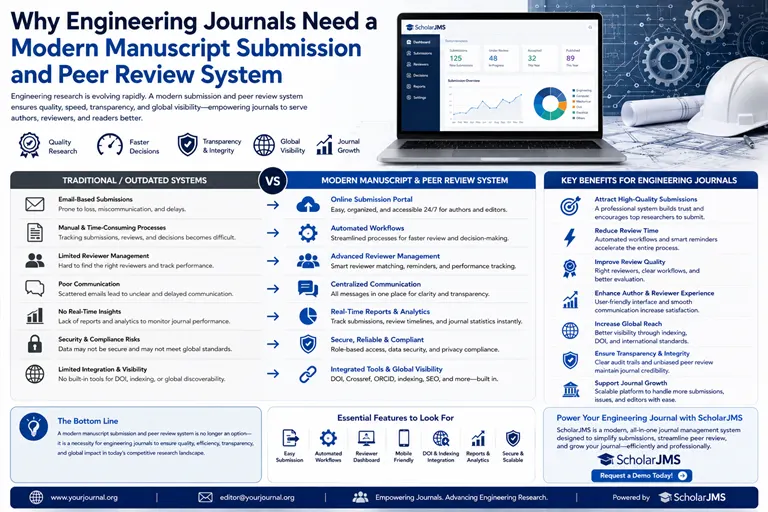
In 2026, a modern manuscript submission and peer review system is no longer a luxury. It has become an essential part of running a credible, scalable, and internationally competitive engineering journal.
The experience of emerging journals, including the Future Edge Journal of Progressive Research (FEJPR), demonstrates that investing in professional editorial workflows can significantly improve publication quality, operational efficiency, and long-term sustainability.
This article explores why modern journal management systems are transforming scholarly publishing and why engineering journals should embrace digital editorial infrastructure.
The Changing Landscape of Engineering Publishing
Engineering research has become:
- Highly interdisciplinary
- Globally collaborative
- Data-intensive
- Fast-moving
- Technology-driven
Authors today expect:
- Easy manuscript submission
- Faster editorial decisions
- Transparent review processes
- Real-time status tracking
- Professional communication
- Efficient publication timelines
Similarly, editors and publishers require systems that can manage increasing submission volumes while maintaining high editorial standards.
Traditional manual workflows often fail to meet these expectations.
Challenges of Manual Journal Management
Many small and emerging journals initially manage submissions through email.
Although this may work temporarily, significant problems emerge as the journal grows.
1. Lost or Mismanaged Manuscripts
Emails can easily be overlooked or misplaced.
Common issues include:
- Duplicate submissions
- Missing files
- Confusion regarding manuscript versions
- Difficulty locating reviewer comments
These problems can delay publication and damage the journal's reputation.
2. Inefficient Communication
Manual workflows require editors to:
- Send emails individually
- Track reviewer responses manually
- Prepare decision letters
- Follow up with authors and reviewers
This consumes considerable time and increases the likelihood of errors.
3. Lack of Transparency
Authors increasingly expect visibility regarding:
- Submission status
- Review progress
- Editorial decisions
- Revision timelines
Without an online system, providing this level of transparency becomes difficult.
4. Reviewer Management Challenges
Engineering journals often rely on experts from multiple countries and institutions.
Managing reviewers manually can result in:
- Delayed responses
- Forgotten invitations
- Inconsistent communications
- Poor reviewer engagement
5. Difficulty Maintaining Publishing Standards
Indexing agencies and research communities increasingly expect journals to demonstrate:
- Structured editorial workflows
- Ethical review processes
- Transparent policies
- Metadata management
- Consistent publishing practices
Modern systems help journals meet these expectations.
What Is a Modern Manuscript Submission and Peer Review System?
A modern journal management platform is an integrated digital environment that manages the complete publishing lifecycle.
The system generally includes:
- Online manuscript submission
- Editorial screening
- Reviewer assignment
- Peer review management
- Revision tracking
- Decision management
- Production workflow
- Article publication
- DOI integration
- Metadata management
- Reporting and analytics
Rather than relying on multiple spreadsheets and email chains, everything is managed from a single platform.
Why Engineering Journals Specifically Need Modern Systems
Engineering journals often handle complex submissions containing:
- Large datasets
- Multiple figures
- Simulation files
- Supplementary materials
- Technical appendices
- Software code
- Multimedia content
Managing these materials manually can become overwhelming.
Modern systems provide structured workflows that simplify manuscript handling and improve overall efficiency.
Key Benefits of Modern Manuscript Submission Systems
1. Improved Author Experience
Researchers prefer journals that offer:
- Simple submission interfaces
- Clear instructions
- Real-time updates
- Faster communication
A professional submission experience encourages repeat submissions and enhances journal reputation.
2. Faster Editorial Decisions
Automation reduces administrative delays.
Editors can:
- Assign reviewers quickly
- Track deadlines automatically
- Send reminders
- Monitor manuscript progress
This significantly reduces turnaround times.
3. Better Reviewer Management
Modern systems support:
- Reviewer databases
- Expertise tracking
- Automated invitations
- Review reminders
- Performance monitoring
These features help journals build stronger reviewer communities.
4. Enhanced Transparency
Transparency is becoming increasingly important in scholarly communication.
Modern platforms provide:
- Complete manuscript history
- Decision tracking
- Communication records
- Audit trails
Such features improve accountability and trust.
5. Increased Publication Efficiency
Automation eliminates repetitive administrative work and allows editors to focus on:
- Research quality
- Editorial decisions
- Strategic development
- Author engagement
The Growing Importance of Digital Editorial Workflows
Engineering journals are increasingly competing internationally.
To attract quality submissions, journals need:
- Professional websites
- Efficient workflows
- Reliable communication
- Transparent review processes
- Modern publishing infrastructure
A journal's editorial system often shapes the author's overall perception of publication quality.
Features Every Modern Engineering Journal System Should Have
Online Submission Portal
Authors should be able to submit manuscripts from anywhere in the world.
Role-Based Access
Separate dashboards for:
- Authors
- Editors
- Reviewers
- Administrators
Automated Communications
The system should automatically send:
- Submission acknowledgements
- Reviewer invitations
- Reminder emails
- Editorial decisions
Peer Review Management
Support for:
- Single-blind review
- Double-blind review
- Open review models
Revision Tracking
The system should maintain complete revision histories.
DOI and Metadata Management
Integration with DOI registration and metadata systems simplifies publication workflows.
Publishing and Archiving
Published articles should be organized and searchable.
Why Peer Review Systems Matter More Than Ever
Peer review remains the foundation of scholarly publishing.
However, reviewers today face increasing workloads.
Modern systems help by:
- Simplifying review submission
- Organizing manuscripts
- Providing clear deadlines
- Maintaining communication records
Efficient systems make reviewers more willing to participate in future reviews.
The Rise of Transparent Peer Review
The scholarly publishing community is increasingly discussing:
- Open peer review
- Transparent review histories
- Recognition for reviewers
- Research integrity initiatives
Platforms such as Scholar9 are helping journals and researchers explore new models of transparency and trust in scholarly communication.
As research ecosystems evolve, journals that adopt modern peer review practices may gain significant credibility advantages.
How Modern Systems Support Journal Indexing Readiness
Indexing agencies increasingly evaluate:
- Editorial quality
- Publishing consistency
- Metadata standards
- Publication ethics
- Digital accessibility
Modern journal platforms help journals maintain these requirements through structured workflows and better documentation.
Why Many Journals Are Moving Beyond Traditional Systems
Many journals initially adopted older journal management platforms.
However, some publishers now seek:
- Improved user experience
- Better design
- Faster performance
- Easier administration
- Modern interfaces
- Enhanced automation
Consequently, many journals are upgrading or migrating their publishing infrastructure.
ScholarJMS: A Modern Journal Publishing Solution
Modern publishing platforms such as ScholarJMS provide integrated solutions for:
- Journal website development
- Manuscript submission management
- Editorial workflow automation
- Peer review management
- Article publishing
- DOI-ready infrastructure
- Archive management
- Editorial communications
Such systems are particularly beneficial for new and growing engineering journals seeking scalable and professional publishing environments.
Need Help Building a Modern Journal Workflow?
We assist journals with:
- ScholarJMS setup and implementation
- Journal website development
- Editorial workflow design
- Peer review system configuration
- Publication infrastructure planning
- OJS migration and support
WhatsApp: +91 82003 85143
Email: inquiry@ojscloud.com
OJS Migration and Publishing Support
Many engineering journals currently using older systems require:
- OJS hosting
- Version upgrades
- Journal migration
- Workflow optimization
- Technical maintenance
Professional support services such as OJSCloud help journals modernize their publishing operations while minimizing technical challenges and downtime.
How Modern Systems Improve Journal Reputation
A professional editorial platform helps journals:
- Build author trust
- Attract quality submissions
- Improve operational efficiency
- Enhance reviewer satisfaction
- Maintain publication consistency
- Prepare for future indexing opportunities
In today's competitive publishing environment, digital infrastructure has become a strategic asset.
Frequently Asked Questions
Why can't journals manage submissions through email?
Email-based workflows become inefficient as submission volumes increase and make tracking manuscripts difficult.
Do small engineering journals need a manuscript management system?
Yes. Even emerging journals benefit from professional workflows that improve efficiency and credibility.
What features should a journal management system include?
Online submission, peer review management, communication tools, metadata management, and publishing workflows.
Is OJS still suitable for journals?
Many journals successfully use OJS. However, some publishers seek newer platforms that offer improved usability, design, and workflow capabilities.
How does a modern system improve peer review?
Automation simplifies reviewer assignment, communication, tracking, and record keeping.
Can modern systems help with indexing?
Yes. Professional workflows and metadata management improve indexing readiness.
Conclusion
The future of engineering publishing depends not only on research quality but also on the efficiency and transparency of editorial processes.
As submission volumes grow and researchers expect faster, more professional publishing experiences, modern manuscript submission and peer review systems have become essential infrastructure for scholarly journals.
Engineering journals that embrace digital transformation are better positioned to improve operational efficiency, attract high-quality submissions, strengthen reviewer engagement, and prepare for long-term indexing success.
The Future Edge Journal of Progressive Research (FEJPR) recognizes the importance of modern publishing technologies and supports innovations that enhance scholarly communication and research dissemination.
Need Help Launching or Modernizing Your Journal?
We can help with:
- ScholarJMS journal website setup
- Manuscript submission systems
- Editorial workflow automation
- OJS migration
- ISSN consulting
- Crossref DOI support
- Journal launch guidance
WhatsApp: +91 82003 85143
Email: inquiry@ojscloud.com